Smart Lighting Solutions for Commercial Spaces: Enhancing Productivity and Ambiance
Modern smart lighting systems are revolutionising commercial environments, offering far more than simple on/off functionality. The aim is to discuss how these systems can transform workspaces, not only by improving energy efficiency but also by significantly enhancing occupant comfort, overall productivity, and creating a flexible, adaptable ambiance. By moving beyond traditional lighting, businesses can invest in a dynamic infrastructure that benefits their bottom line and their employees' well-being.
Transforming the Commercial Environment with Smart Lighting
Traditional commercial lighting is static, often leading to wasted energy and environments that don't support the diverse needs of employees throughout the day. Smart lighting provides a dynamic solution that addresses these challenges head-on.
Boosting Productivity and Well-being
Scientific research consistently shows that lighting quality has a direct impact on employee performance and health. Smart lighting systems allow for the implementation of Human-Centric Lighting (HCL), which is designed to support the body’s natural circadian rhythm.
Circadian Rhythm Support: Automated systems can adjust the colour temperature and intensity of light throughout the day—cooler, brighter light in the morning for focus, gradually shifting to warmer, softer light in the evening to prepare for winding down.
Reduced Eye Strain and Headaches: Personalised or localised dimming and glare control can be implemented, significantly reducing the common complaints of eye strain and light-induced headaches, leading to fewer sick days and higher concentration.
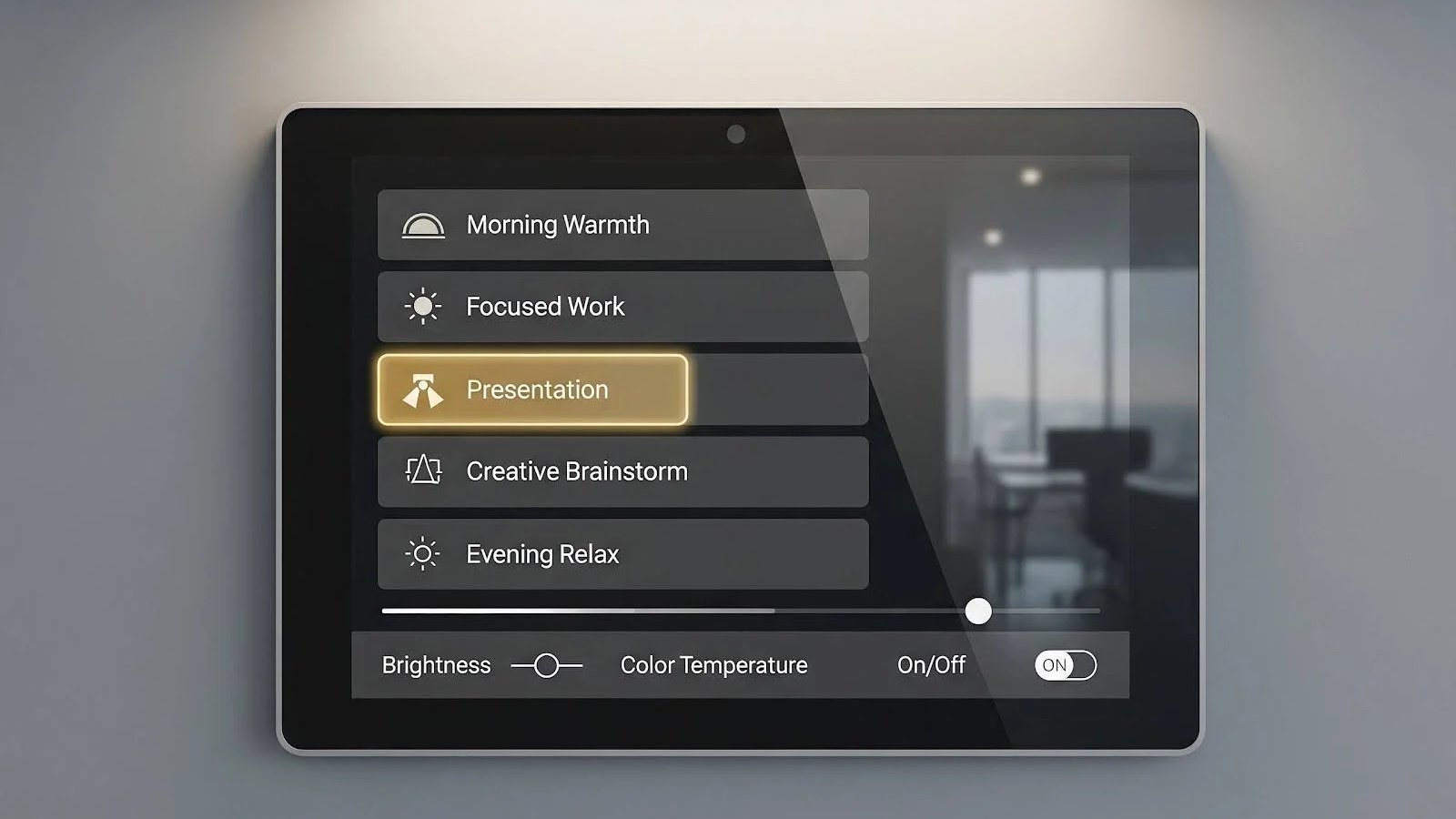
Ambiance Control: Different work areas—from collaborative spaces and meeting rooms to quiet focus zones—require different lighting. Smart systems allow for instant scene recall, creating the perfect ambiance for every task, thereby supporting flexibility and collaboration.
Achieving Maximum Energy Efficiency
One of the most immediate and tangible benefits of commercial smart lighting is the dramatic reduction in energy consumption and operating costs.
Presence and Absence Detection: Integrated sensors ensure that lights are only on when an area is occupied. In areas like storage rooms, toilets, and unused meeting rooms, this leads to substantial energy savings.
Daylight Harvesting: Systems can automatically measure the amount of natural daylight entering a space and dim artificial lights accordingly, maintaining a consistent, comfortable light level while using minimal energy.
Detailed Usage Analytics: Smart lighting provides granular data on energy use. This allows facilities managers to identify areas of waste and continually optimise the system for peak performance and efficiency.
Future-Proofing and Integration
Investing in a smart lighting system is an investment in the future of the workspace. These systems are designed to be scalable and to integrate seamlessly with other building management systems.
Seamless Integration: Modern smart lighting platforms can communicate with HVAC, security, and access control systems, allowing for unified building automation and more complex, efficient operational routines. For example, when the security system is disarmed, the lights can automatically adjust to the "pre-opening" scene.
Remote Management: Facilities teams can monitor and manage the entire lighting infrastructure from a central dashboard, making maintenance and troubleshooting simpler, often without the need for an on-site visit.
Scalability: A well-designed smart lighting system can be easily expanded as the business grows or as the office space is reconfigured, avoiding expensive and disruptive rewiring.
To truly harness the power of professional-grade smart lighting, it’s essential to partner with experts who understand the nuances of commercial environments. For a truly intelligent and energy-efficient workspace that supports your team’s productivity and well-being, get in touch with us today to discuss how a professional commercial lighting solution can transform your business space.
Frequently Asked Questions
-
The main benefits include significantly enhanced energy efficiency, improved employee well-being and productivity through Human-Centric Lighting, and the creation of flexible and adaptable ambiance settings for different tasks.
-
While the initial installation cost may be higher than a basic traditional system, the investment offers a rapid return through substantial, long-term savings in energy consumption and reduced maintenance costs.
-
Professional smart lighting systems are designed for integration. They often use open protocols and can be networked with existing Building Mana
-
Daylight harvesting is an energy-saving technique where sensors measure the available natural light and automatically dim the artificial lights to the minimum level required to maintain a consistent, pre-set brightness level, thereby saving energy.
-
By implementing Human-Centric Lighting, the system mimics natural light cycles, which helps regulate employees' circadian rhythms, improving alertness during the day, reducing eye strain, and ultimately leading to higher levels of focus and concentration.